Thursday Thoughts: A Kinder Way to Practise When Public Speaking Feels Hard

You do not have to become fearless before you begin speaking. You only need a safe enough first step. 🌸
If you are a GCSE student who goes quiet when it is time to present, or a neurodivergent speaker whose thoughts become tangled under pressure, public speaking can feel like a very large mountain.
The room feels brighter.
Everyone seems to be watching.
Your carefully planned words suddenly hide behind a frosty window.
This is where a kinder approach to presentation skills training can help. Not “just get on with it”. Not “stop worrying”. Not endless repetition until you feel worn out.
A kinder approach gives your brain structure, your body a pause button and your voice permission to sound like your own.
With gratitude to every student, parent, carer and teacher who keeps showing up for difficult moments: your effort matters, even when it is quiet. 💛
First, let us make public speaking smaller
When you are experiencing a fear of public speaking, the idea of “practising a speech” can sound enormous.
It might mean:
Standing in front of a whole class.
Remembering every sentence perfectly.
Making eye contact with everyone.
Speaking without your voice shaking.
Answering unexpected questions.
Being judged if your mind goes blank.
That is a lot for any nervous system to hold.
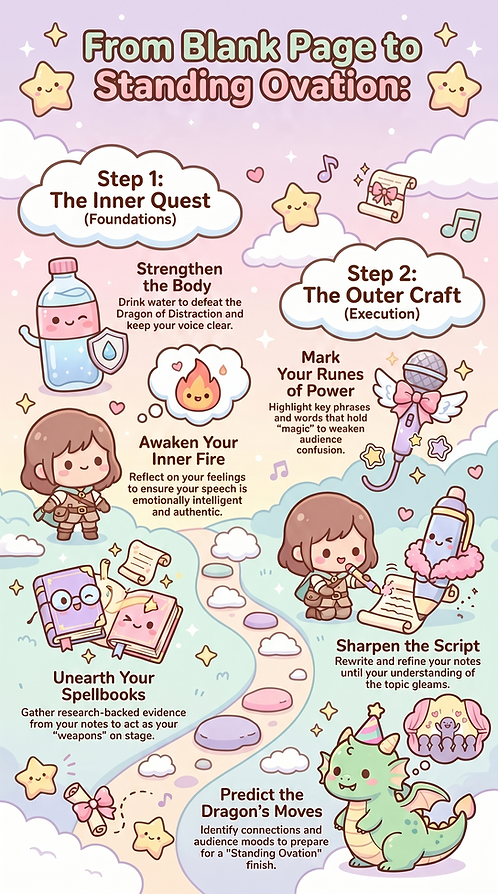
So instead of beginning with the full performance, begin with one manageable piece. Think of it as building a little stepping-stone path through a glistening stream.
Try this sequence:
Read the opening sentence silently.
Read it aloud to yourself.
Say it while looking at your notes.
Say it to one trusted person.
Add the next sentence when you feel ready.
You can stop at any stage. Progress is not cancelled because you need a pause.
Are you the adventurer who wants to try the whole path today, or the dreamer who prefers to place one stepping stone at a time? Both are valid. 🌈
Practise the shape before the script
One of the gentlest ways to prepare a speech is to learn its shape rather than memorise every word.
This reduces cognitive load. It also gives you something steady to return to if your thoughts wander.
Try dividing your presentation into four simple parts:
Opening: What is your topic?
Point: What is the main idea?
Evidence or example: What shows that your point matters?
Closing: What would you like your audience to remember?
For a GCSE English spoken presentation, this could look like:
“Today I am going to explore…”
“My main point is…”
“We can see this when…”
“So, the most important thing to remember is…”
Write these sections on separate cards or in clearly labelled chunks. You are not creating a tiny mountain of notes. You are making a friendly map.
The aim is not to sound robotic. The aim is to give your brain a handrail.
Use a short practice loop
Long rehearsal sessions can sometimes make public speaking anxiety louder, particularly when you are already tired, overstimulated or worried about getting things wrong.
Instead, try a five-minute practice loop:
Minute one: settle
Sit somewhere comfortable. Reduce unnecessary noise if possible. Adjust the lighting. Keep a drink nearby.
If sensory input affects your focus, consider:
Headphones or ear defenders before practising.
A quieter room.
Minimal motion on your screen.
A plain or adjustable background.
A fidget item or comfortable movement.
A familiar chair, blanket or jumper.
These are not distractions. They may be part of the support that helps your brain stay available for speaking.
Minute two: brain-dump
Write down every thought about the presentation. Messy thinking is welcome.
Do not organise it yet. Let the ideas tumble onto the page like leaves in an autumn breeze.
Minute three: choose three anchors
Select only three key ideas. These might be:
A quotation.
A technique.
An example.
A personal response.
A conclusion.
If an idea does not support your purpose, place it in the tiny bin mini-game. You are not declaring it useless forever. You are simply choosing not to carry everything at once.
Minute four: speak one section
Read or say one short section aloud. Focus on meaning, not performance.
Ask yourself:
Was my main idea clear?
Did I give the audience somewhere to go?
Did I pause when I needed to?
What felt even slightly easier?
Minute five: finish kindly
Write down one thing that worked.
Not five things to fix.
One thing that worked.
That small record becomes evidence. Over time, it creates a tapestry of progress that anxiety cannot easily dismiss.
Do not force eye contact
Eye contact is often presented as a rule. It is not a measure of your intelligence, confidence or respect.
For some neurodivergent speakers, direct eye contact is uncomfortable, distracting or exhausting. You can still connect with an audience by:
Looking at foreheads or eyebrows.
Looking just above people’s heads.
Looking at a friendly point on the wall.
Returning to your notes when you need to.
Moving your gaze naturally rather than holding it.
Your goal is communication, not performance of a particular social behaviour.
You are allowed to speak in a way that supports your brain.
Build in a pause button
When public speaking anxiety rises, your body may move into alert mode. Your heart beats faster. Your shoulders tighten. Your thoughts speed up or disappear.
A pause is not a failure. A pause is a tool.
Before you begin, try:
Pressing both feet gently into the floor.
Relaxing your jaw.
Taking one slower breath out than in.
Feeling the weight of your notes or device.
Naming three things you can see.
Saying your first sentence more slowly than feels natural.
You can also build pauses into the speech itself:
“The first point I want to explore is…” Pause. “This matters because…”
That little space gives your audience time to follow you and your brain time to organise the next thought.
Try private, non-judgemental guidance
Some speakers find it easier to practise when another person is not watching them.
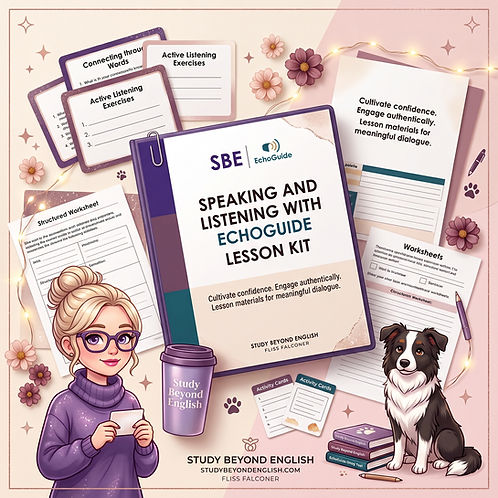
That is one reason EchoGuide can be a helpful companion for speech rehearsal. It offers private, real-time guidance as you read aloud. It can highlight the next word, follow you when you paraphrase and provide gentle support without turning practice into a test.
EchoGuide is designed around privacy and dignity:
No recordings.
No shaming.
No punitive scoring.
No pressure to sound perfect.
Dyslexia-friendly fonts.
Adjustable backgrounds.
Calm visual modes.
Support for different cognitive and sensory needs.
That means you can practise the act of speaking without an audience waiting to judge every wobble.
You might use it to rehearse:
The opening of a GCSE spoken language presentation.
A quotation from Macbeth or Romeo and Juliet.
An explanation of a writer’s methods.
A short answer before sharing it in class.
A presentation where you want to practise pacing and pauses.
The purpose is not to replace your voice. It is to give your voice somewhere safe to stretch.
Keep feedback small and useful
After practising, avoid asking, “Was I good?”
That question can invite a very large and unhelpful answer.
Try asking:
What was clear?
Where did I sound interested?
Which sentence needs a little more support?
Where could I add a pause?
What is one small change for next time?
If someone is giving you feedback, ask them to offer:
One strength.
One practical next step.
This is micro-coaching, not criticism. It keeps your attention on growth instead of inviting your inner critic to deliver a full-length lecture.
And if you make a mistake? You have not ruined the speech. You have gathered information about what to practise next.
A gentle GCSE English practice plan
The GCSE English: Sorted Learning Hub supports students with accessible, chunked learning across Literature, Language and learning skills.
The Hub includes a single membership tier at £15 per month, with lessons designed to be completed in manageable steps and revisited when needed.
The free taster includes:
The first two lessons of Macbeth.
The first two lessons of Romeo and Juliet.
The first two lessons of AQA Language Paper 1.
The first two lessons of AQA Language Paper 2.
You can use these lessons to practise a calm rhythm:
Learn one idea.
Write one response.
Say one response aloud.
Notice one strength.
Take a pause.
That is presentation skills training without the harsh edges.

Your voice does not need to be flawless
The aim of speaking practice is not to erase every nervous feeling.
It is to help you discover that you can speak while feeling nervous.
You can pause.
You can look at your notes.
You can rephrase.
You can begin again.
You can sound thoughtful, enthusiastic, quiet, funny, serious or wonderfully yourself.
So, this Thursday, try one tiny rehearsal. One sentence. One breath. One moment of courage.
Thank you for practising. Thank you for trying again. Thank you for making room for your own voice. 🧠💛
Comments