Resilience as a Superpower in Adaptive Leadership

Resilience in Motion: How Our Experience Equips Us to Support Others
05 October 2025
Fliss Falconer
‘Ch- ch- ch- changes...’
I’ve never coped well with change. The irony isn’t lost on me: my craving for novelty and variety clashes with my discomfort when change is imposed. The internal tug-of-war between initiating change and having it thrust upon me is exhausting.
At 38, on my level 7 apprenticeship course, I was sitting in a classroom, waiting for a professor to arrive. I knew they were a different professor to the last one. I knew their name. I’d had a glimpse at a corporate-style image. I’d even only spent no more than 5 hours in the company of the last one. Yet, I had to consciously poise myself in my chair so I wasn’t slumped, pouting and tapping my foot. This is all my issue, not theirs, I hasten to add.
Some would even say that this could have been my comeuppance in disguise. I have left classes of pupils early myself. Caused that ‘left in the lurch’ feeling. Twice due to maternity leave, once for a change in staffing and once when I left teaching in the April rather than the August.
Although I doubt any of my own students would have been in a petulant mood due to my absence, it made me think about why I was so antagonistic about this known change, when change is inevitable and dealing with it effectively can be a fundamental skill for life.
Then, the new professor started to speak. ‘Resilience’ was discussed.
Put your armour on
I have taught pre- and post-pandemic, and where resilience was discussed as crucial to holistic teaching of our students, it became clear that we needed to ensure that our pupils were geared up and ready to fight the good fight for their own self-respect and self-endurance. I foolishly thought that these were part of the ‘lost’ skills that had come from two years of lockdown. Last week, we discussed how many adults struggle to cope with our modern way of life, and we need to ensure that we are all equipped and ready to stand tall. There is no getting away from the fact that pandemic years were tough for everyone - everyone was in the same storm, but hardly the same boat. Some people are still recovering today.
In my role, we work with a deep commitment to the Support First ethos and strive to ensure that legal intervention is the last avenue for persistent absence. Parents, carers, schools and other professionals are doing all they can to support their pupils who may be struggling to cope with the life post-pandemic, as it is nothing we have experienced in our lives before. We have a clear and well-mapped path for legal intervention with stops, checks and areas for exploration before legal intervention is undertaken. Even when it is, the cycle of support never ceases. We will not rest if there is a safeguarding concern for a pupil. And attendance is a safeguarding concern.
We must work on preparing our children to cope with the world as it is today and do all we can to prepare them for the future. This is not new. We are passing on the baton from previous generations. What did your parents face when you were being brought up? Your grandparents for them? And before that?
Everyone’s a Superhero these days
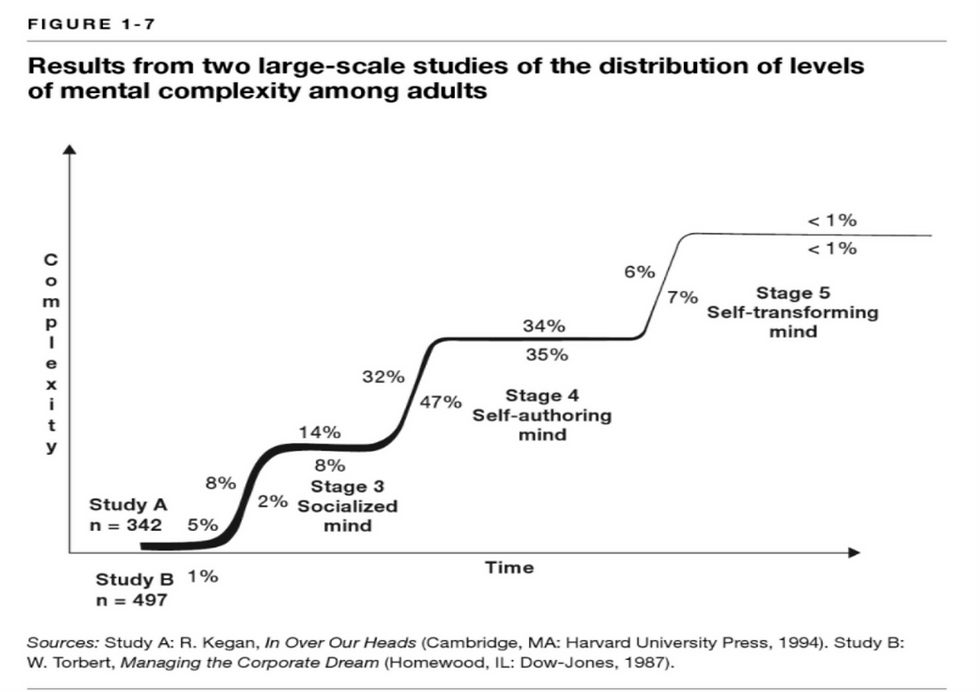
As part of the organisational changes we were discussing for the module, we considered Kegan’s In Over Our Heads (1994) and Torbert’s Managing the Corporate Dream (1987), where adaptive leadership’s stages of understanding aim for the capacity to thrive, and develop resilience and immunity to change. Kegan’s theory suggests that modern life demands mental complexity beyond what many of us are equipped for. Torbert’s work invites leaders to evolve through stages of meaning-making, aiming for transformation rather than mere adaptation. In a post-pandemic world, these frameworks feel more urgent than ever. Leadership now demands not just resilience, but a kind of cognitive agility that can keep pace with seismic shifts. It is not enough to be learning the leadership skills that were taught 5 years ago. Too much has changed, and we have been catapulted into a world that looks a lot like the ‘normal’ we once knew, but is all so different, too.
Who would have thought that we would return to normal anyway? I remember friends sharing posts on Facebook listing the mad times we were living through. Our world felt so dystopian, so alien, and we feared that we would never have ‘normal’ again. Lives were lost. Hindsight has shown us so much. Investigations, retributions, and recoveries are still underway.
But how can we think about this and find the positivity, the resilience, and the power to keep going?
Slingshot into the Future
The horrors of WWI, where bodies were shattered by artillery, and medics improvised under fire, forced medicine to evolve in real time. As the Imperial War Museums note, “the war created a medical emergency on an unprecedented scale,” pushing doctors and nurses to learn through action, not theory. History Hit echoes this, describing how “the urgency of war accelerated innovation,” with breakthroughs in surgery, infection control, and mental health care emerging directly from the battlefield. Artists’ drawings and poetry from their first-hand experiences supported the visualisations for teaching books and journals. Under the real ‘life and death situations’ in which they worked, meteoric advancements were made; their legacy continues to teach us today.
Just as WWI forced medicine to evolve under fire, the pandemic accelerated our technological and cultural evolution. The deeper technological and cultural transformations it sparked include:
“🧠 Beyond Zoom: Key Technological Advancements in the UK
Cloud-based systems: 69% of UK firms adopted cloud computing during the pandemic, enabling secure remote access to data, collaboration tools, and business systems.
Artificial Intelligence (AI): 9% of firms began using AI, especially in large service and manufacturing sectors. AI-supported automation, customer service, and data analysis.
Robotics and specialised software: Manufacturing firms leaned into robotics for continuity, while service sectors adopted niche software for HR, finance, and project management.
Cybersecurity upgrades: With remote work came increased cyber threats. Organisations invested heavily in secure networks, VPNs, and endpoint protection.
Digital infrastructure expansion: The UK government and private sector accelerated broadband rollout and digital inclusion initiatives to support remote communities.
🏡 Birth of the WFH Culture: How the Pandemic Reshaped Work
Hybrid working models: The pandemic normalised flexible arrangements—home, office, or blended. This shift was especially pronounced in knowledge-based sectors.
Management transformation: Firms had to upskill managers in remote leadership, trust-building, and digital communication. Strong management practices correlated with higher tech adoption.
Work-life balance redefined: Employees reported improved autonomy but also blurred boundaries. This led to new norms around digital well-being and asynchronous work.
Inclusion and accessibility: Remote work opened doors for disabled workers, carers, and those in rural areas—though disparities in tech access remained a challenge.
Cultural reframing: WFH became more than a policy—it became a symbol of trust, autonomy, and modernity. Organisations began branding themselves around flexibility and employee empowerment.”
I would not be able to have my current role if remote working were not still available and an accepted culture for the company. I am very remote from the office, and when I am in the office, I must adopt a hugely different working style. At home, I can take the children to school, come home, and work diligently. I have alarms to remind me to break. (I may as well have a bell that signals the end of class!). At work, I am constantly apologising for talking to myself and I am conscious of making noises that may disturb my colleagues... let’s face it, I need a sign on my back that says ‘Please do not disturb me, as I am easily distracted. I will talk to you and neither of us will get any work done!’
We have adapted to using OneDrive, Sharepoint (-ish!) and Windows 11. Teams and Copilot run my life. Gemini will add items to my calendar, emulating a bored and irritated assistant. (I’ve tried to give feedback to her that she makes me feel like an idiot. She may as well be rolling her eyes at me as she apologises!)
Under pressure of necessity, we transformed our way of living with the technology and workplace culture, and we were resilient with it because we had to be.
Taking the pressure off now should not slow down our advancements and certainly not diminish our can-do attitude. We have shown the world that we can be a thriving community and cope despite the changes being thrown at us.
What’s more, we have shown what we can do under that pressure. What can we do now when we are no longer trying to keep ahead of the storm? Let’s keep the pedal to the metal and really see what we can do.
Resilience isn’t just a skill, it’s a legacy. We inherit it, shape it, and pass it on. So let’s sit tall in our chairs, meet change with curiosity, and keep building the future we deserve.
References
Department for Science, Innovation and Technology. UK Innovation Survey 2023. https://www.gov.uk/government/statistics/uk-innovation-survey-2023
History Hit. Ways in Which World War One Revolutionised Medicine. https://www.historyhit.com/ways-in-which-world-war-one-revolutionised-medicine/
Imperial War Museums. Medicine in the First World War. https://www.iwm.org.uk/history/medicine-in-the-first-world-war
Kegan, R. (1994). In Over Our Heads: The Mental Demands of Modern Life. Harvard University Press.
Office for National Statistics. Business and individual attitudes towards the future of homeworking, UK: April to May 2021. https://www.ons.gov.uk/releases/businessandindividualattitudestowardsthefutureofhomeworkingukapriltomay2021
Torbert, W. R. (1987). Managing the Corporate Dream: Restructuring for Long-Term Success. Dow Jones-Irwin.
Comments