What If the Way Words Look Is the Reason a Story Gets Lost?

02 May 2026 | Fliss Falconer
I want to tell you about a student I taught years ago. She was funny, dramatic, wildly imaginative, and she adored theatre. She could describe a scene with the kind of vivid detail that made you see it. But put a programme in her hands or ask her to read a synopsis off a screen and something shifted. She'd go quiet. She'd hand it back. The words, she told me once, kept moving.
She wasn't disengaged. She was dyslexic. And the world of theatre, for all its welcome and warmth, hadn't thought about her enough.
That moment has stayed with me. It's part of why the EchoGuide Theatre inside Study Beyond English exists, and why I'm particularly proud of what we've built into it for learners like her.

What EchoGuide Theatre Actually Does
EchoGuide is Study Beyond English's AI-assisted learning companion, and EchoGuide Theatre is a dedicated app designed to bring theatre to life for young people in a way that is accessible to them. It's a genuine learning environment that supports oracy, comprehension, critical thinking and creative response, all through the lens of live performance and dramatic storytelling.
What makes it meaningful, rather than just functional, is that it's been designed with the full range of learners in mind from the start. Not as an afterthought nor as an accessibility add-on bolted to the side.
Dyslexia Support: Fonts, Colours and the Right to Read Comfortably
One of the features I'm most pleased about is the dyslexia support built directly into the Theatre Spotlight. Learners can choose from dyslexia-friendly fonts, including OpenDyslexic, and adjust background colours and text contrast to suit how their eyes and brain work best.
This matters more than it might sound. When a young person spends cognitive energy just trying to decode the shape of letters on a screen, they have less left for the ideas, the story, the joy of it. Reducing that visual friction isn't a small thing. It's the difference between being inside the experience and being locked outside it.
I think about that student often when I work on this. She deserved a tool that thought about her before she even arrived at it. So do thousands of others who love stories and struggle with print as it's usually presented.
The font and colour choices in EchoGuide aren't buried in a settings menu. They're accessible, simple and genuinely usable. That was a conscious decision, because if support is hard to find, it isn't really support.
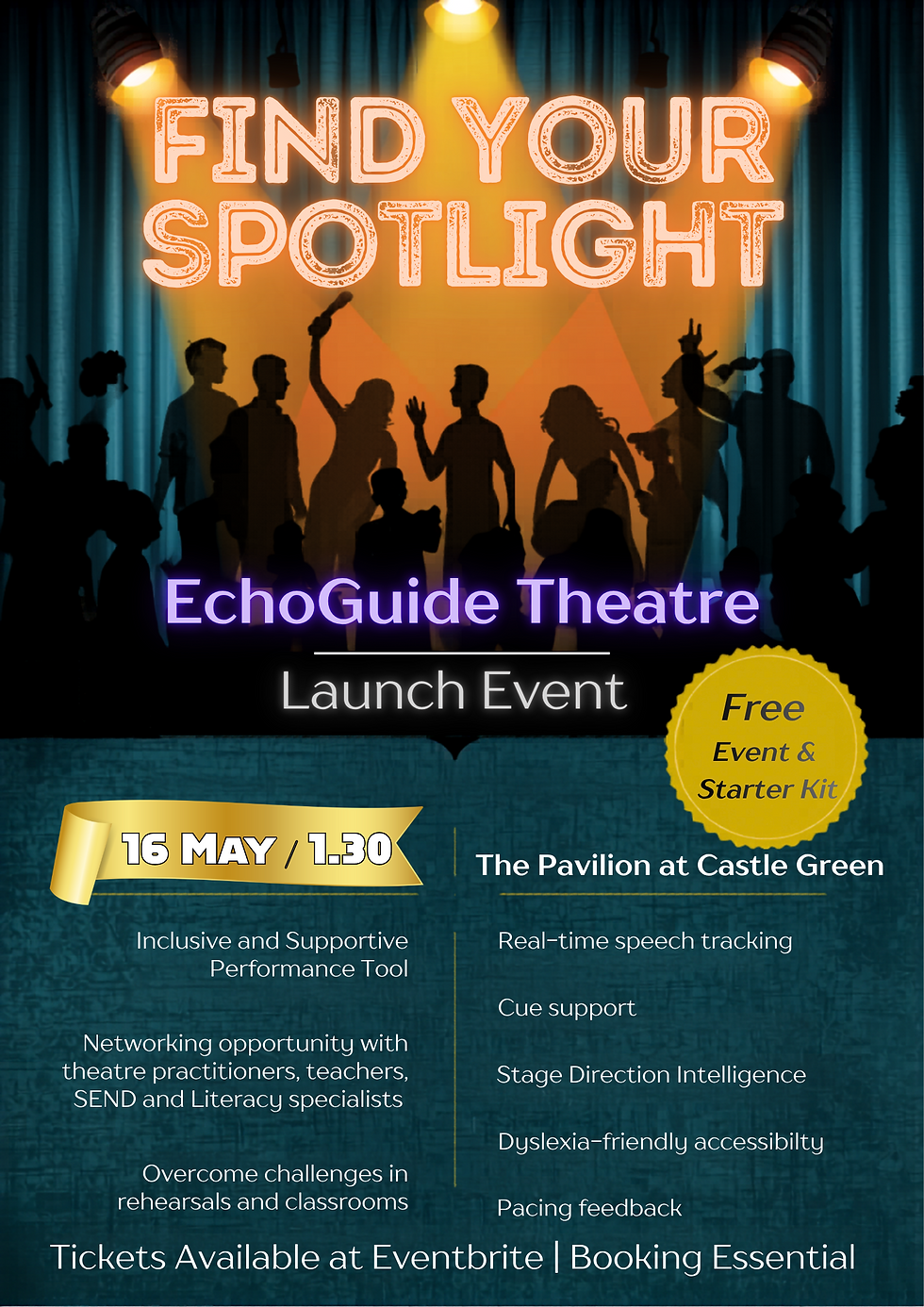
Join Us for the EchoGuide Theatre Launch on 16 May
On 16 May, we're holding a live launch event for EchoGuide Theatre, and I would genuinely love to see you there. Whether you're a teacher thinking about how to bring more theatre into your literacy work, a parent who wants to support a child who finds reading stressful, or someone who simply believes that storytelling belongs to everyone, this event is for you.
We'll be walking through the features, including the dyslexia support tools, and talking about the thinking behind the design. There will be space for questions and conversation, because that's the kind of community Study Beyond English is trying to build.
Tickets are available now on Eventbrite. Search for Study Beyond English or follow the link in my bio.
Theatre has always believed in the power of a story to reach someone. I want EchoGuide to hold that same belief, and make sure the words on the screen never get in the way of it.
Come and see what we've made. I think you'll feel the care that's gone into it.
🌸📚🐾🖥️✒️☕🌸
Comments